coverage
Archived Posts from this Category
Archived Posts from this Category
Posted by ben on 21 Aug 2009 | Tagged as: art + bikes, conceptual art, coverage
In my first post in a long time over at Glasstire, I call out Elaine Wolff for her characterization of Daniel Saldaña as “post-contemporary.” I like the pieces he has on display at David Shelton Gallery, but her implication that his art is at odds with current art-making trends is a stretch, and I think a misreading of what’s happening in the art world.
Posted by ben on 09 Jul 2009 | Tagged as: announcements, coverage
Chad Dawkins attempts to review every visual art exhibit on the Contemporary Art Month calendar on a blog created for the project: Publicity Stunted. So far he’s off to a good start, though more images could help. We’ll see if he can keep up the momentum through this weekend, which looks pretty packed.
Posted by ben on 24 Jun 2009 | Tagged as: arts organizations, books, conceptual art, coverage, design, photography, responses/reviews
Dan Goddard, the Express-News’ long-time art critic who was recently canned in a round of layoffs, has just published two good articles dealing with Linda Pace properties. In the San Antonio Current, he discusses the fate of Pace’s storied art collection, and it’s forthcoming permanent home. Designed by British architect David Adjaye specifically for the Pace collection, the project is on hold due to the economic downturn. Apart from that news, which I’ve been hearing unofficially for a while, Goddard reveals many interesting tidbits about the collection, Linda’s personal relationships with various artists, and the ongoing activities of the foundation. I was excited to learn that the Linda Pace Foundation is funding a public work by Jesse Amado to be installed at the downtown library (it will surely be a welcome contrast to their Chihuly).
On Glasstire, Goddard reviews Jonathan Monk’s “Rew-Shay Hood Project Part II” at Artpace. There’s some good context here for understanding the subtleties of the show, from Monk’s history with appropriation to Rucsha’s Catholic background, right down to curator Matthew Drutt’s obsession with vehicle-related art. That Goddard brings up Dave Hickey’s discussion of Ruscha is interesting, given Hickey’s interest in custom cars as an artistic medium. Some people I’ve talked to about the show come away with the impression that Monk is having the Ruscha photos painted on car hoods from the same period; Goddard points out this isn’t the case, the hoods come from one or two decades later than the photos. Perhaps what’s going on here is a contrast between the beginning of the idea of an “artist’s book” (the move away from the artist creating singular, unique objects) and the end of the era of the custom muscle car. As Goddard points out, the push for more efficient, less polluting cars using computer technologies pushed out custom car hobbyist culture to a large extent. But the rise of these computer technologies also empowered artists to move into their own mass production, at the same time allowing the kind of appropriation that Monk himself uses. Although Ruscha wasn’t using computers to produce Twentysix Gas Stations (and I don’t know if Monk used them in his reproductions), they are the descendents of the mass-production technologies that printed Twentysix Gas Stations, and Monk’s relevance certainly has a lot to do with them. Thus in the show we have the suggestion of a kind of ebb and flow, technology and the markets at certain points inspiring very personal expression, at other points depersonalizing art even to the point that it becomes design. And isn’t Monk here acting more like a designer than an artist, if by design we mean depersonalized visual communication?
Posted by aaron on 15 Jun 2009 | Tagged as: coverage, design, music, rock!, typography
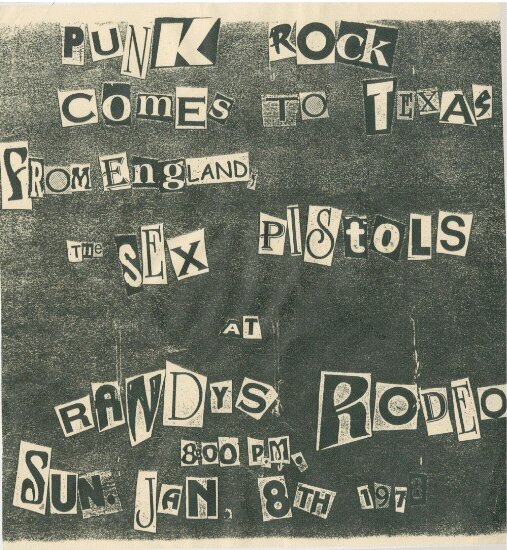
An apparently forged Sex Pistols flyer fools Christie’s authenticators and ignites controversy amongst internet rock’n'roll/design geeks.
As part of an ongoing project archiving San Antonio music flyers on my Facebook page, I have been frequenting the website Gigposters.com to comb through its San Antonio-related contributions. Early last week, I came across a singular new addition – the flyer pictured above, purporting to be from the Sex Pistols notorious Randy’s Rodeo concert in San Antonio on January 8, 1978. (Headline from the next day’s Express-News: “Pistols Win S.A. Shootout.”) The third date on the Sex Pistols short-lived American tour, it has gone down in punk rock lore as the concert at which Sid Vicious, after being repeatedly hit in the face with airborne full cans of beer, retaliated against the offending audience member’s head (and possibly innocent bystanders as well) using his bass guitar.
Posted by ben on 10 Mar 2009 | Tagged as: adventure day, coverage, responses/reviews
I’ve spent the last two weekends in Austin for the No Idea Festival and then the Texas Biennial (I hope to have impressions from those up this week, so stay tuned). This weekend San Antonio takes the stage with with some massive events: LACMA’s Phantom Sightings (featuring San Antonio artists Alejandro Diaz and Cruz Ortiz) travels to the Alameda on Friday alongside Caras Vemos, Corazones No Sabemos, the same day SAMA opens a Ry Cooder-commissioned piece by Vincent Valdez and an installation by John Hernandez. Saturday brings the second annual Luminaria arts night, which seems to be more expansive and better-organized than the first.
For background on the well-received Phantom Sightings, see Christopher Knight’s review in the LA Times, and some photos on Flickr.
We’ll do our best to post reactions and reviews in a timely manner, but we’re getting blasted with art from every direction down here in South Texas…
Posted by ben on 06 Mar 2009 | Tagged as: art paparazzi, coverage
The Current reports on Blue Star director Bill FitzGibbons‘ attempt to rally community support for saving Dan Goddard’s job as art editor at the Express-News. Goddard had been at the Express-News for over two decades before he was swept away in a massive round of layoffs at the Hearst-owned daily (according to this the paper eliminated 165 positions, including 75 from the newsroom — word on the street is that they are merging operations with the Houston Chronicle). During the time that I’ve been paying attention, he’s generally been considered a reasonably well-informed, but unambitious art journalist. In conversation, he hinted that his desire to cover smaller grassroots art spaces taking risks was discouraged by his bosses, who wanted mostly safe, factual reviews of museum shows. Since the layoffs, Elda Silva seems to be covering the visual arts, with brilliant, insightful posts like this (the first post covering visual art in almost 2 weeks — astute readers may notice we’ve removed Art Beat from our blogroll).
It is disconcerting to have the only daily paper in San Antonio all but abandon visual art coverage. But at the same time, it’s pretty clear that the Express-News never saw critical arts coverage as an important part of its mission, and that Goddard didn’t have the will or the leverage to change that. I agree that art awareness in San Antonio will suffer due to the loss of Goddard at Express-News, but I’m hopeful that this gap will inspire fresh blood and new critical perspectives to enter the arena.